Review by Willie Caldwell
The Ghostlight Stage Company marked World AIDS Day with an intimate and emotionally charged devised art piece that brought renewed attention to the continuing realities of HIV and AIDS. Created in partnership with Caracole, the performance balanced stark honesty with compassion, guiding the audience through the complex terrain of fear, stigma, and resilience that accompanies an HIV-positive diagnosis. At its core, the piece explored hope and acceptance, not as easy resolutions, but as acts of courage that emerge from deep vulnerability and community connection.
The Premise
The original script by Aiden Dalton weaves together three interlocking narratives drawn from in-depth interviews with real people living with HIV in Southwest Ohio. A preshow announcement noted that the interviews were compensated for their time, an important detail that underscores Ghostlight Stage Company’s ethical commitment to honoring and valuing the stories being shared onstage. The result is a triptych of perspectives that feel both theatrical and documentary, inviting the audience into an intimate proximity with the characters’ fears, failures, and hard-won resilience.

Mary’s story follows a middle-aged Black woman who contracts HIV from her husband after his same-sex affair, a betrayal that spirals into addiction, rehab, and slowly, a measure of self-forgiveness. Her narrative lingers in the messy process of recovery and the fragile emergence of acceptance while delivering humor, sass, and personal reflection.
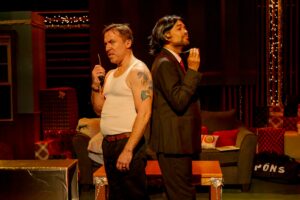
Chris, portrayed by himself, offers the perspective of a young white man from rural small-town Ohio whose HIV diagnosis stems from unprotected sex, with no clear sense of who transmitted the virus. As an aspiring actor, Chris reflects on how living with HIV complicates his relationships, shapes his ambitions, and shadows his sense of possibility.
Travis’ narrative centers on a flamboyant Black fashion designer who moves to Los Angeles to chase his creative dreams, only to find that his HIV status becomes a crucible for growth rather than an ending. He frames his diagnosis as a source of unexpected strength and perspective, suggesting that living with HIV has, in some ways, made him a better, more grounded person.
Together, these three arcs create a tapestry of queer, Black, and rural experience that resists any single “type” of HIV story. Each of the narratives is intimate and deeply personal, highlighting the varied ways people navigate stigma, love, and self-worth while living with HIV. Even as modern treatment can render a person’s viral load undetectable (and thus un-transmittable) the characters still collide with ignorance, shame, and fear in their families, beds, and social circles. Across their stories, themes of love, loss, sex, humor, and discomfort surface again and again, ultimately bending toward hard-earned hope and acceptance rather than easy catharsis.
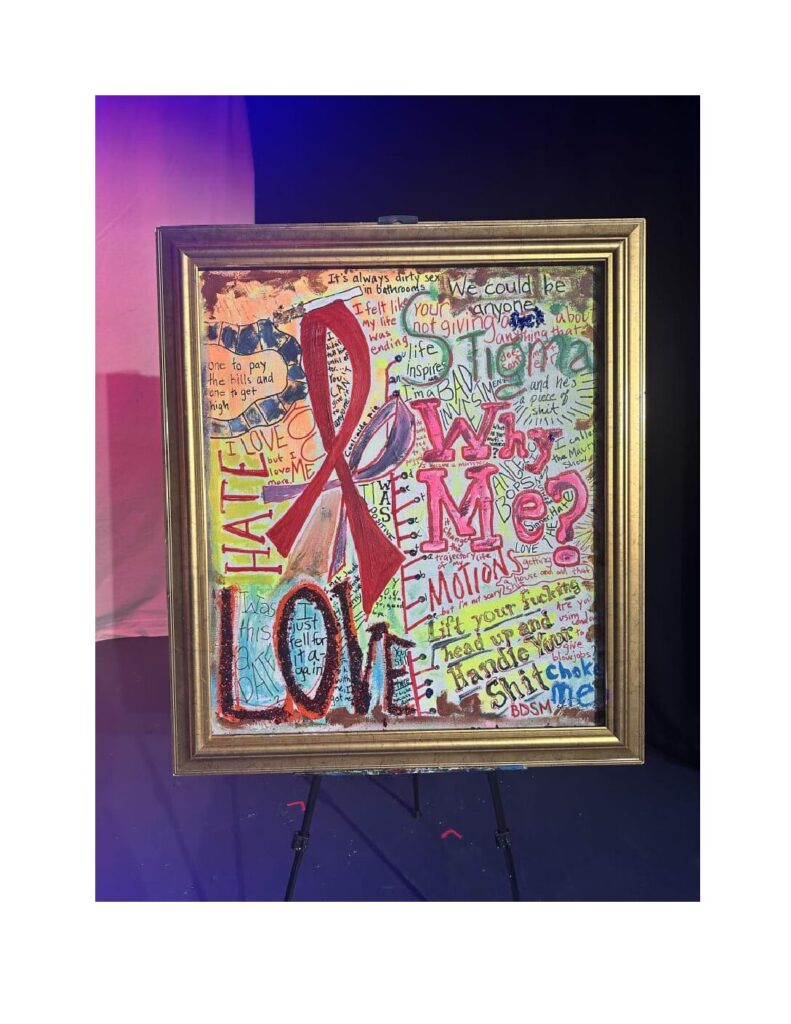
Movement pieces by choreographer Darnell Pierre Benjamin translate the emotional weight of diagnosis and ongoing survival into gesture-based physical language. Repetitive motions, subtle shifts, and evolving patterns of contact echo the looping cycles of anxiety, disclosure, and resilience that accompany life with HIV. Meanwhile, a live painting created by artist James Reynolds during the performance adds a visual element before becoming a silent-auction item that extends the piece’s impact beyond the final blackout.
The Actors
Marva Williams-Parker delivers a standout performance as Mary, infusing the character with such grace and heartfelt realism that it often feels as though the real Mary is present in the room. She balances humor and sass with natural ease, creating a portrayal that is both compelling and deeply empathetic. Chris Logan Carter, playing himself, skillfully navigates the delicate territory between acting and personal testimony. It is very apparent that the emotional output on stage is very real and very personal. Jeffery J Jackson embodies Travis with unwavering commitment that also blurs the lines between character and actor.
The structure of the piece–where two performers bring to life the documentary-style accounts of others and one recounts his own lived experience–cultivates a profound suspension of disbelief, allowing reality and theatricality to merge in ways that are both moving and thought-provoking.
The sheer dedication to honoring these stories creates a sense of urgency and importance that makes any minor stumbles or hesitations easily forgivable. Ultimately, the ensemble’s commitment ensures that the audience comes away feeling as though they have been entrusted with personal confessions from friends and neighbors, fulfilling the deeper purpose of the evening and the play as a whole.
The Production
Under the direction of Aiden Dalton, Your Neighbor embraces a minimalistic approach that suits the Falcon Theatre’s intimate, close-quarters environment. Rather than relying on elaborate sets, props, or costumes, the production locates its power in the charged space between actor and audience, where eye contact, breath, and silence carry as much weight as any design choice. In this stripped-down context, the emotional clarity of the performances becomes the primary engine of meaning, and in that respect, the production shines.
The creative team (Assistant Director Ariel Mary Ann, lighting designer Leo Jenkins, and producer Alyssa Batsakis) clearly understands that theatre at its most essential is an act of shared storytelling. Their work frames the piece with care and purpose, using light, pacing, and staging to invite the audiences to step, if only briefly, into someone else’s reality. The result feels thoughtfully crafted by artists who understand that at its core, theatre is about telling a story and allowing audiences to walk a mile in another person’s shoes.
Listed as Dalton’s final season with Ghostlight before relocating to New York City to further his career, Your Neighbor also carries the quiet resonance of a farewell. It reads both as a culmination of his work with the company and a statement of artistic values: theatre that is intimate, community-focused, and grounded in real human experience.
Final Thoughts
Your Neighbor is a thought provoking experience of devised theatre that celebrates and uplifts individuals living with HIV/AIDS. It was a single, one-night performance that I was honored to be a part of.
Those that missed the event may still expereince a recording of the piece which will be available December 8-15 to stream online anytime anywhere. Link to register for free for recording is: https://www.zeffy.com/en-US/ticketing/ghostlight-x-caracole-your-neighbor-virtual-viewing
For more information about The Ghostlight Stage Company visit their website at www.theghostlightstageco.com