By Shawn Maus
A Rom-Com Assembled from Familiar Parts
Somewhere inside Waiting for Fair is a funny romantic comedy about six friends trying to understand sex, love and why other people insist on making both so complicated.
F.J. Hartland’s play, presented as part of Cincinnati LAB Theatre’s 2026 New Works Festival, begins with Marisol reluctantly going on a blind date with Troy. When she later describes their first sexual encounter as merely “fair,” the comment travels through their circle of friends, rattling the relationships of Natasha and Bo, and Chase and Eli.
The play wants to skewer stereotypes about relationships, gender, sex and classic movies. What arrives onstage is a romantic comedy for the digital age that somehow remains stuck in several earlier ones. It carries the quick rhythms of a television sitcom, the comfortable familiarity of an ’80s or ’90s rom-com and traces of the old Hollywood tearjerkers its characters frequently discuss.
There are flashes of Friends, When Harry Met Sally… and a lot of Neil Simon, particularly in the opening act. Hartland likes puns, quips and characters who know how to deliver a punchline. The audience laughed often, and there is genuine pleasure in watching six actors bounce jokes around the stage.
But Simon’s comedies work because something painful usually sits beneath the laughter. In Waiting for Fair, the jokes often arrive before the characters have developed enough weight to support them.

The Relationships Skip Steps
Marisol is the clearest example. She wants to date, yet seems irritated by the fact that dating requires another person. She pushes Troy away, draws him back and quickly moves into a sexual relationship with him, but the play does not give us enough understanding of what she wants, what she fears or why Troy becomes important to her.
By the time the couple reaches a picnic where Marisol expects Troy to propose, their relationship has advanced several emotional chapters which the audience never gets to see. We are told Natasha tipped her off, but the proposal itself is not the real surprise. The surprise is that the relationship has apparently reached that point at all.
Several later developments arrive with the same suddenness. A pregnancy appears without enough preparation. Major decisions are explained after they happen instead of being built through scenes. An epilogue adds another ending without deepening the one that came before it.
Director Aaron Epstein and assistant director Elliot Handkins make smart choices to help the audience follow the play’s jumps through time. The transitions are generally clear. The harder jumps are emotional. Characters enter a new scene having changed their minds, their relationships or their futures, leaving the audience to catch up.
Waiting for Fair does not need to become a different play. It needs to slow down long enough for us to believe the one it is already trying to be.
The Cast Keeps it Moving
Jake Hart brings excellent comic timing to Troy. His facial expressions could reach a balcony, had the Bell Tower Arts Pavilion possessed one. Even when Troy’s emotional arc remains incomplete on the page, Hart makes him appealing and gives the audience someone to follow.
Alaska Dunn is another standout as Natasha. She finds more beneath the dialogue than the play consistently provides and becomes the connective thread among the three couples. Natasha feels like someone who has lived beyond the punchlines.
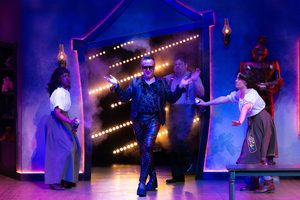
Reece Niederhausen gives Chase a broad, theatrical energy reminiscent of Nathan Lane in The Birdcage. The performance occasionally pushes too far, but Niederhausen commits fully and knows how to deliver a joke. Mike Rochester brings an easy steadiness to Eli.
Gavin Handkins gives Bo the weary patience of a man who has spent too much time surviving his friends’ relationship problems.
Fiona Moody’s opening scenes as Marisol are often too soft for the Bell Tower space, and several lines are difficult to catch. She grows easier to hear as the evening continues. The larger problem belongs to the script: Marisol’s motives remain difficult to read even when every word is clear.
Fair… for Now
Hartland knows how to build a joke, and the cast earns plenty of laughs. What is missing are the emotional steps between attraction, commitment, pregnancy and marriage. Too often, the characters arrive at major moments before the audience has been allowed to travel with them.
For now, the title supplies the verdict. Waiting for Fair is fair: enjoyable in the moment, well served by several strong comic performances and guided by a director making sensible choices with a script that still needs work.
Why the Workshop Matters
Cincinnati LAB Theatre deserves credit for continuing to put unfinished plays in front of audiences. A workshop is where the gaps are supposed to show. Actors test the language, directors discover where the script needs help, and audience reactions tell the playwright what the page could not.
Waiting for Fair already has the laughs. What it needs now are the emotional steps that carry its characters convincingly from attraction to commitment. The audience laughed, the performers committed fully, and the talkback gave Hartland something more valuable than polite applause: honest evidence of where the play connects—and where it still needs work. That is exactly what a new works festival is for.
Waiting for Fair returns Friday, July 24, at 7:30 p.m. at the Bell Tower Arts Pavilion, 3270 Glendale Milford Road in Evendale. Tickets and information about the 2026 New Works Festival are available at cincylabtheatre.com.
Shawn Maus is a Cincinnati-based writer, award-winning screenwriter, and communications professional with a deep passion for storytelling in all its forms. Holding an MFA in Screenwriting and a BFA in Electronic Media, Shawn brings a cinematic eye and narrative flair to his theatre reviews. As the owner of Shawn Maus Copywriting and Marketing, he manages digital content, social media, and newsletters. In his reviews for the League of Cincinnati Theatres, Shawn blends his love for theatre and classic cinema with a keen appreciation for live performance, offering readers insightful and engaging perspectives on the local theatre scene.