By Liz Carman
Northern Kentucky University’s School of the Arts’ production of Little Women: The Musical features a collection of performances that far surpass the material in the show itself.
Little Women has been a beloved childhood story for generations. The semi-autobiographical novel by Louisa May Alcott tells the story of the four March sisters growing up in Civil War-era New England. As they grow into very different women, with different values, goals, and passions, they remain closely bonded through sisterly love.
It’s unfortunate, then, that the musical adaptation flattens all individuality out of all four March sisters, and spends nearly three hours for very little story or character development, with few notable tunes in the score.


A Cast of Shining Star Quality
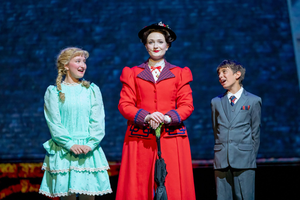
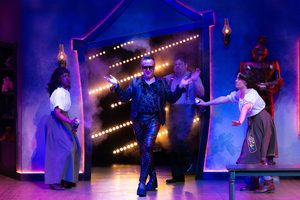
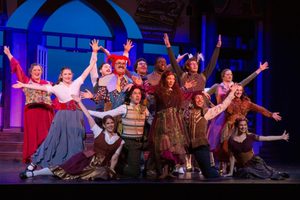
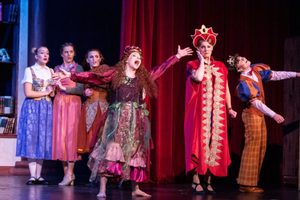
The cast of NKU SOTA’s BFA candidates, brings vivaciousness and palpable joy to the stage that elevates the very little given to them by the script, and they do so in very fine voice. Sydney Hall is a suitably irrepressible Jo. The role was originated on Broadway by Sutton Foster, which leaves big shoes to fill, vocally speaking, and Ms. Hall rises to the challenge with power and verve. Riley Griffin adeptly embodies Amy, the baby of the family, from childhood to womanhood with a naturalistic grace. She is entirely believable at both ends of the story’s time jump. Kylie Mobley’s snappy comedic timing brings an unusual witty spark to usually-staid oldest sister Meg, and Lorelle Stewart shines sweetly as the frail Beth.
Katelyn Thatcher rounds out the household as matriarch Marmee, and exudes a warmth and maturity that is rare to see in a young actor. As suitors to the March girls, Joshua Edwards, Isaiah Burton, and Daniel Gnau all carry off their romantic-lead moments with charm and an admirable bend toward the female gaze; Mr. Gnau in particular left me longing to see him more onstage.

Black Box Staging’s Triumphs and Challenges
Little Women: The Musical brings a tennis-court seating style to NKU’s Strauss Theatre black box, with audiences on two facing sides and the action down the center of the space. It’s a layout that requires thought and skill from actors and director, but it’s thrilling to watch when it works as well as it does here. Director Kat Moser-Priddy admirably steers her performers around the space, and the physical storytelling is strong enough that I didn’t feel left out of the story even when actors had their backs toward me. Jamey Strawn serves as Music Director and Jeri Gatch as Choreographer. Costumes are by Lee O’Rourke, set pieces by Erikah Powers with props by Ron Shaw. Lighting is by Jo Sanburg.
Regrettably, the production’s vocals are underamplified and the space itself is not acoustically resonant; while the action is clear from all angles, the words are often not, particularly in sung moments. I often struggled to understand the lyrics when actors were turned away from me, and this was a problem for just about the entire cast – only Dakara Cooper, as the stridently imposing Aunt March, was consistently audible, and Isaiah Burton as “Laurie” Laurence was nearly so.

Overall
While I cannot claim to have felt any warm feelings for the musical itself, the talent and skill on display from these preprofessional artists, really made the production into an engaging evening worth watching.
See for yourself. Little Women: The Musical runs through October 4, 2026. Tickets are available at the NKU Box Office.