By Liz Eichler, ATCA
Make time this weekend to see either cast of CCM’s Sweeney Todd—one of the program’s strongest musical productions in recent years.
Considered one of Stephen Sondheim’s masterworks and a cornerstone of musical theatre, musical director Ian Axness brings out the best in both Opera and Musical Theatre students. From the tender solos “Johanna” and “Not While I’m Around” to the rolling thunder of “The Ballad of Sweeney Todd” and “City on Fire,” the score is in strong hands. He leads a top-notch orchestra, ensuring audiences feel the vibration of the organ, catch the delicate details, and sway with the well-known rhythms. (Rafael Roig-Francoli and Kerrigan Mandrell alternate as concertmaster.)
Director Vincent deGeorge, alongside associate director Heidi Lauren Dukeas, crafts striking stage images and sustained tension. A standout moment comes as Anthony and Johanna attempt their escape, passing dangerously close to the Judge and Beadle—an edge-of-your-seat sequence that fully invests the audience. DeGeorge also leans into the show’s dark humor, particularly through Mrs. Lovett, while allowing glimpses of something softer—and more unsettling—in Todd himself.
The production resists rushing, allowing moments to breathe. From the overture—where the stage slowly fills with the unseen poor—to the manic energy of Mrs. Lovett’s scenes, the pacing feels deliberate and highly effective. Choreographer Brandon Kelly brings kinetic life to the bustling ensemble, capturing both the energy and chaos of the city.

Synopsis
Set in the smoky, industrial world of 19th-century London, Sweeney Todd begins on the docks as Todd returns from exile in Australia, where he was unjustly imprisoned by Judge Turpin and the Beadle. Seeking revenge for the loss of his wife and separation from his daughter Johanna—now under Turpin’s control—Todd reestablishes himself as a barber on Fleet Street.
As Johanna lives under the Judge’s watchful eye, a young sailor, Anthony, falls for her and dreams of escape. Meanwhile, Todd forms a grim partnership with Mrs. Lovett, whose struggling pie shop takes a macabre turn as he awaits the chance to exact his revenge.

Lead Performances
The four principal roles are double cast, alternating between opera and musical theatre students.
Harrison Hancock, a second-year Master of Music (MM) Voice student, delivers a compelling Sweeney Todd. His rich bass-baritone pulls you in and gives you goosebumps. He commands the stage with a menacing presence and strong timing.
Claire Strong’s Mrs. Lovett leans fully into the character’s eccentricity and dark humor. Her performance effectively captures Lovett’s manipulative charm and comic energy.
Nick Gundrum brings earnest sincerity to Anthony Hope, while Maya Sharma’s Johanna highlights vocal warmth, her vibrato adding to her delicacy.
Alternate performers include Anargha Pal (Sweeney Todd), Peyton Kern (Mrs. Lovett), Jack Hicks (Anthony), and Zoë Meier-Juhlin (Johanna).

Featured Standouts
Will Ryan as Judge Turpin is commanding and confident. His duet “Pretty Women” with Hancock is a highlight—beautifully sung and dramatically gripping. Bottle that and patent it.
Jack Keller’s Beadle provides a slimy, menacing counterpoint, along with well-timed humor that shines in song. A crisp high tenor, he is both pompous and ridiculous, particularly in “Parlor Songs.”
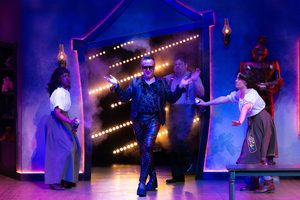
Cameron Howard’s Pirelli is a hoot—a foppish yet shrewd showman—but it is J. Perry’s Tobias who earns our affection. His “Not While I’m Around” is *chef’s kiss* delivered with clean, rich tones.
Chloe Lezotte’s Beggar Woman moves throughout the stage with striking physicality, bringing both levity and urgency as she pleads for alms.
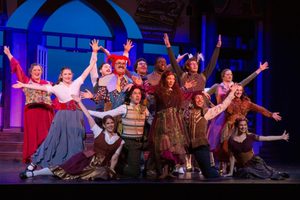
The ensemble meets–and often exceeds–the demands of the piece well, shifting between the unwashed masses and more defined moments in the spotlight with clarity and energy. The Ensemble includes: Maddie Belanoff, Kade Bennett, Alexander Bowman, Max Cohen, Ellie Eisele, Edward Ferran, Wesley Geary, Jonathan Hobbs, Javy Jones, Matthew Juhlin, Amelia Lamb, Avery Sanderlin, Kayla Sconiers, Sydney Short, Calista Smith, Declan Smith, Vivien Stringfellow, Sam Yousuf, Tanya Harris, Ahhyun Baek, and Vex Blocker.

Design and Technical Elements
The first staging of the Sweeney Todd story was in 1847 at a “bloodbath theatre,” designed to thrill and shock audiences. This production does not lean into gore; instead, it emphasizes character, using light (Jules Cabrera) and shadow to build tension and atmosphere.
The industrial set (Mark Halpin) is striking in scale—a towering warehouse structure with metal staircases and a functional lift that raises and lowers Todd’s shop. Combined with rolling units and factory elements, it evokes the harsh and gritty world of Fleet Street.
Costumes by CJ Kelly clearly delineate class: the poor are layered in texture, while the wealthy appear in refined fabrics. Act Two subtly reflects Todd and Lovett’s success through their elevated appearance. Standout pieces include Mrs. Lovett’s Act One look, Johanna’s white dress, and Pirelli’s look, as well as Todd’s outfits and traveling clothes.
One drawback is sound balance. At times, vocal amplification struggles against the 31-piece orchestra, leaving some performers difficult to hear.

Overall
CCM’s Sweeney Todd is a compelling, visually striking production—and a must-see.
While I’ve enjoyed the 1980 production with George Hearn and Dorothy Loudon, John Doyle’s take, and a number in between, this production admirably rises to the occasion.
Tickets
Get tickets now—this will likely sell out. Call the Box Office for availability at (513) 556-4183. Running only through April 19. (PLEASE CCM–add a Sunday Night performance!) Get more information HERE
- April 15 at 8 p.m.
- April 16 at 8 p.m.
- April 17 at 8 p.m.
- April 18 at 2 p.m. and 8 p.m.
- April 19 at 2 p.m.