Backed by a strong ensemble and sharp direction, the production builds into a carefully constructed interplay of chaos and control that pays off again and again. This is a comedy RSVP worth saying yes to.
By Afshin Razi
Bliss This Mess
First staged in 1925, Noël Coward’s Hay Fever has endured for over a century because it understands something fundamental about human behavior. Put a group of self-absorbed artists in a room, add unsuspecting guests, remove all sense of social etiquette–and comedic gold unfolds.
At the center of the chaos is the Bliss family, each member delightfully theatrical and completely unaware of the emotional wreckage left in their wake. Coward’s writing is crisp and sharp, filled with biting wit and a keen understanding of performance both on and off the stage. These characters treat everyday life as theatre, constantly “playing” to one another, which makes the weekend’s unraveling all the more hilarious.
What makes Hay Fever feel fresh even today is its clever structure and surprisingly progressive undercurrent. The fluidity of identity, relationships, and expression reads as quietly modern, giving Coward’s comedy a resonance that extends well beyond its 1920s setting. At its core, the play’s sharp social satire (particularly its send-up of self-involved artists and performative personalities) feels strikingly familiar to contemporary audiences. The Human Race Theatre Company’s production, in collaboration with Wright State University, captures this beautifully, balancing the period’s elegance with a clear understanding of the play’s biting wit. The result is both sharply observed and effortlessly entertaining.

The Magnificent Nine
The production features a tight ensemble of nine performers, and every single one of them is outstanding–even at the preview I attended. This is one of those rare ensembles where every performer feels essential, and more importantly, fully in sync with one another. Even when not the focal point, the background work is alive with detail, adding layers of humor that reward a wandering eye.
Skye Hodgkin brings a sharp, restless energy to Sorel Bliss, capturing both the character’s impulsiveness and keen awareness of the madness surrounding her. Char Adams as Simon Bliss leans into the character’s artistic intensity, grounding the role just enough before letting the comedy bloom in perfectly timed bursts. Jennifer Joplin’s Clara is a standout, navigating the chaos with a sense of exasperated control that makes every reaction land.
Teri Clark Linden as Judith Bliss is simply a force. There is a commanding theatricality here that feels right at home in Coward’s world, turning even the simplest exchange into a full performance. James Walker’s David Bliss offers a beautifully measured counterbalance, blending dry humor with a subtle awareness of the absurdity he helped create.
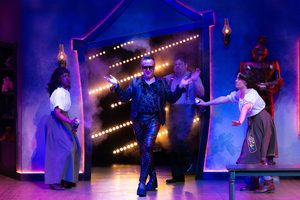
Kieran Cronin traces a sharp arc as Sandy Tyrell, evolving from eager guest to quietly desperate escape artist. He is countered by Philip Drennen’s Myron Arundel, a burst of flamboyance that feels brilliantly in step with Coward’s spirit. Evelyn Vordtriede brings a sincerity to Jackie Coryton that weaponizes the character’s discomfort for big laughs, while Jared Joplin’s Richard Greatham acts as the audience’s anchor—a grounded foil whose frantic search for a “civilized” exit makes the Bliss family madness even funnier.

The Fever Is in the Details
Director Robert Hetherington understands that Hay Fever lives and dies by its rhythm, and this production moves in perfect unity. The pacing is crisp, the transitions are seamless, and the escalating misunderstandings build with satisfying momentum. The show never feels rushed, but it also never loses its grip on the audience.
Joseph Tilford’s scenic design creates a believable and inviting 1920s home, one that feels lived in by a family of artists. It provides the perfect playground for the chaos to unfold. Kelsey Gallagher’s lighting design subtly guides the audience’s focus, while Erin Eva Butcher’s costumes are a visual highlight. The period detail is strong across the board, with Myron Arundel’s wardrobe standing out as a particularly delightful expression of character.
Annabell Mallard’s sound design supports the world without overpowering it, and Sarah Gomes’ props work adds texture and authenticity, giving the actors tangible tools to heighten the comedy.
Final Verdict
HRT’s Hay Fever is a finely tuned comedic machine powered by a stellar ensemble and confident direction. It is smart, stylish, and consistently funny. Most importantly, it reminds us why Coward’s work continues to resonate. Human behavior, especially at its most self-indulgent, never really goes out of style.
Tickets to Hay Fever
Hay Fever runs April 8 – April 19, 2026. Tickets are on sale through the Dayton Live Box Office, 937-228-3630, or online at www.humanracetheatre.org
Running time: Approximately 2 hours of performance, with one 15-minute intermission.