By Doug Iden
The March family women endure hardships and uncertainties while the American Civil War ensues in this musical version of Little Women at the Strauss Theater at Northern Kentucky University.
The Plot
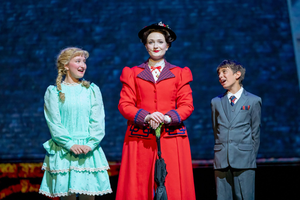
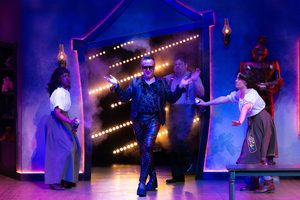
Based upon the beloved novel by Louisa May Alcott, four sisters, approaching adulthood, and their mother learn to survive and thrive while their father is off at war. The story is told primarily through the eyes of rebellious and independent sister Jo (Sydney Hall) who aspires to be a professional writer. In 1865, Jo is plugging a story she just wrote to Professor Fritz Bhaer (Daniel Gnau), a fantastic tale of piracy and derring-do. The story is then enacted in a humorous version by the ensemble. Unimpressed, Bhaer insists she can do better. In flashback, we see Jo and her sisters Meg (Kylie Mobley), Beth (Lorelie Stewart), and Amy (Riley Griffin) acting out the story with little enthusiasm. Their mother Marmee (Katelyn Thatcher) returns and tries to establish stability and strength, masking her own trepidations which only manifest in her songs.
Jo cuts down a neighbor’s tree for Christmas which enrages Mr. Lawrence (Luc Vanderbroek) but leads his grandson Laurie (Isaiah Burton) to defend her and, eventually fall in love with her. Laurie’s tutor John Brooke (Joshua Edwards) also intercedes and becomes smitten with Meg. Wealthy Aunt March (Dakara Cooper) offers to take Jo to Europe but is aghast at Jo’s temperament and appearance. Amy is more conducive to Aunt March’s notion of women’s suitability. The remaining story is the bonding of the family and blending the male characters into the fold.

Themes
This is a story rich with themes and texture. Foremost, it is about family, love and relationships. It also embraces 19th Century feminism as espoused by Alcott, Austin and the Bronte sisters. The four March women represent different personalities and accepted places in society and yet, despite some turmoils, bond into an enduring sisterhood. Other themes include classism, rich vs. poor, the devastation of war and survival.
Musical Numbers
The music, which harkens back to older shows, by Jason Howland is lush, melodic and varied. Lyrics by Mindi Dickstein tell stories and represent the characters but I had some difficulty hearing some of the singers. Hall as Jo has the majority of the songs including solos and ensemble pieces. Her best numbers are anthems to her independence, spunk and determination including “Better”, “Astonishing” and “The Fire Within Me”. She also sings duets and ensemble pieces including “Could You?”, “Five Forever” and “Small Umbrella in the Rain” plus a poignant duet with the dying Beth “Some Things are meant to Be”. Thatcher (as Marmee) poignantly displays her inner turmoil in “Here Alone” and then encourages Jo to continue writing with “Days of Plenty”. Her voice is strong and rich.
Burton (Laurie) enthusiastically pleads his case to Jo before romancing Amy with the duet “The Most Amazing Thing”. Mobley (Meg) and Edwards (Brooke) pledge their mutual love in “More Than I Am” and Mr. Lawrence (Vandenbroek) softens towards the Marchs and Beth with the duet “Off to Massachusetts”. A lot of the humor comes from the spirited reenactments of Jo’s stories with “An Operatic Tragedy” and “The Weekly Volcanic Press” performed by the ensemble.

Production and Creative Team
The Strauss Theater is small, intimate and perfect for this type of show with seating on two sides and the “stage” in the middle. Small set pieces, designed by Erikah Powers, connote a meager 1860’s house include bookshelves, chairs, a fireplace (a significant plot point) and a second story attic which doubles as Jo’s writing area. Many props by Ron Shaw include a fir tree, a moveable chest, wedding flowers and an umbrella. Lighting by Jo Sanburg is atmospheric.
Costumes by Lee O’Rourke are interesting because they suggest mid-19th Century garb but also embody modern apparel. Most of the characters wear pants (for the men) or skirts (for women) with vests or shawls and white shirts. Jo, however, wears trousers (verboten in those days) with a bright red sweater displaying her “modern” disposition. Costumes for the reenactments include pirates, French musketeers and rags. Onstage music includes three instruments led by pianist and Producing Artistic Director Jamey Strawn. Director Kat Moser-Priddy has masterfully orchestrated the acting while choreographer Jeri Deckard created the whimsical dances.
Overall
This is a heartfelt, warm, emotional and loving production of an American classical story. All of the elements work well. The ensemble cast excels but Hall as Jo carries the day. She is very believable as the rambunctious, independent and fiery Jo who ultimately matures and comes to grips with herself and those around her. Hall’s singing anthems are highlights. Other excellent performances include Thatcher, Griffin, Stewart, Burton and Cooper.
So, dust off your Civil War uniform and march on down to Northern Kentucky University’s production of Little Women, the Musical running through October 4, 2026. Order tickets at boxoffice@nku.edu.