By Liz Eichler
Bring your TV “news” addicted friends to Cincinnati Shakespeare Company’s production of Network. Either side of the political aisle might find it eye-opening.
What they will see is the how the sausage is made and how the magician does his tricks.
Have you ever considered if TV news shows telling the truth or manufacturing “news” to get ratings?
Corporate News
Network is based on the 1976 film of the same name by Paddy Chayefsky, adapted for the stage by Lee Hall. Bryan Cranston won awards in productions in both London (2017-18) and New York (2018-2019) for his portrayal of Howard Beale.
Set in September 1975, we watch veteran and respected news anchor Howard Beale unravel live on the air. When his supervisors realize his outrageous rants are earning ratings, the network decides to capitalize on his tirades, giving the audience what it wants. It looks nothing like the news shows of the past.
It might open some eyes to see the machinations of a corporate television conglomerate chasing the dollar rather than seeking the truth—as we like to believe the great Walter Cronkite once did. Truth (or truthiness) doesn’t sell anymore.
“We’re not in the business of morality, we’re in the business of business.”
Since 1976, the screen has become smaller and moved into our pockets, creating echo chambers and silos. It’s not necessarily news we are consuming, but A/B-tested headlines and hooks designed to pull in the most engagement.
And what gets engagement? Do we respond when we are happy? No. We react when we are uncomfortable or mad.
Beale leads his audience—and us—to shout:
“We’re mad as hell and we’re not going to take it anymore!”
The audience gets to yell it at least 10 times. And it feels so good.

Large and Talented Cast
Jim Hopkins delivers a phenomenally strong Howard Beale. He is commanding and slightly unhinged, but as he dives deeper into becoming a prophet, he actually becomes less unhinged. Hopkins is taking on the role that earned Bryan Cranston a Tony Award on Broadway, and he makes it his own.
Speaking of Bryan Cranston…he’s part of the cast!
Specifically for Cincinnati Shakespeare’s production, Cranston appears as Arthur Jensen, the big boss of the conglomerate. His presence adds another layer of fun to a production that is already playing with the idea of who controls the message.
Director Brian Isaac Phillips ensures the rest of the ensemble believably builds the chaos of a live television broadcast, from camera operators and makeup artists to directors and technicians. Upper management is appropriately pompous when dealing with underlings. Yet Brent Vimtrup’s Frank Hackett goes from intimidating to schoolboy-giddy at the success of Beale’s increasingly outrageous broadcasts. Such a good scene with Phil Fiorini as Ed Ruddy.
Hayley Guthrie’s Diana Christensen is strongly alluring, ambitious and laser-focused on growing market share. She understands exactly what her audience wants—and is willing to give it to them. She’s also a woman aware of her skills, limitations, and needs. Admirable in the 1970s as well as now.
Barry Mulholland’s Max is caught in a difficult place, trying to be honest to his longtime friend and colleague Howard. He’s also navigating new territory, professionally and personally, with the female executive who has a crush on him. One note: Mulholland could turn up the volume, as the open set swallows some of his more intimate musings.

Production Team
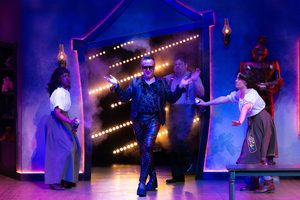
The set (Jon Savage) is expansive, using the open wings to reveal the studio while rows of lighting equipment in the back create the almost factory-like atmosphere of a newsroom.
There are 12 TV-sized monitors and one huge screen dominating the space. Those monitors are used with both 1975 footage (Patty Hearst, President Ford assassination attempt, etc.) as well as live video amplifying the live action. There are also snarky subtitles to the scenes (some getting laughs), as they change from newsroom to restaurant, to apartment and back again. That means somewhere backstage, production stage manager Danitza Piper is calling almost 600 cues to keep the show running smoothly. Director Phillips set the pace but she ensures the “On Air” sign is called to light up at 4 seconds to go every time.
Kudos to the media team (Robert Carlton Stimmel) for keeping the live video so tightly synchronized with what is happening onstage. Nice work for the sound team (Zack Bennett) adding an extra click before the slides are projected, ensuring authenticity of the era. Also, we need a playlist for the nostalgic yet appropriately chosen music selections.
Costumes (Erin Reed Carter) highlight the ’70s styles reflected in the 3-piece suits and ties, plaids, patterns and flares in all the best ways. Finally, the lighting (Baxter Chambers) helps define spaces not in the studio. For example we know we are in a bar when the actors are bathed in a square of red light.

Overall
This is a powerful, topical show, professionally presented. Hopkins and the entire ensemble are convincing, and the technical aspects are top-notch.
Director Phillips allows the script to speak as it leans heavily into the inescapable crush of capitalism, the evolution of mass media and the hypocrisy of the times. He highlights the constant redefinition of the network’s goals, from
“We’re not in the business of morality, we’re in the business of business” to:
“There is no America, no democracy. There is only IBM, ITT, Ford, GE, Exxon. Those are the nations of the world….What exists is the endless primordial movement of money…The world is a business, Mr. Beale.”
Network certainly gives you something to talk about after you leave the theatre.
That’s one of the pleasures of live theatre: We sit in the dark together, watch a story unfold, laugh, yell, cringe—and then walk out and start talking about it.

Tickets
Cincinnati Shakespeare Company’s production of Network runs through September 26, 2026. Highly recommended. I want to see it again!
Tickets: https://cincyshakes.com/
Box Office: 513-381-2273
Running time: About 2 hours, including one intermission
Content Advisory: Gunshots and other loud noises, strong language, discussions of suicide, simulated sexual activity, theatrical haze and flashing lights.
Directed by: Brian Isaac Phillips
Scenic Design: Jon Savage
Costume Design: Erin Reed Carter
Lighting Design: Baxter Chambers
Sound Design: Zack Bennett
Media Design: Robert Carlton Stimmel
Wig Design: Kayla Cieslinski
Fight and Intimacy Director: Alicia Rodis
Stage Manager: Danitza Piper
Assistant Stage Manager: Tessa Killen
Harry Hunter: Geoffrey Warren Barnes II
Sheila/Secretary 2: Jasimine Bouldin
Floor Manager/Secretary 1: Eva Olivia Catanzarita
Jack Snowden/Warmup Guy: Montez Jenkins Copeland
Nelson Chaney: Cary Davenport
ELA Member/Shooter: Giles Davies
Ed Ruddy: Phil Fiorini
Diana Christensen: Hayley Guthrie
Interviewer Voice/TV Technician: Candice Handy
Howard Beale: Jim Hopkins
Schlesinger/Continuity Announcer: Kelly Mengelkoch
Louise Schumacher: Connan Morrissey
Max Schumacher: Barry Mulholland
Director: Patrick Earl Phillips
TV Technician/Sound Guy: Robert Carlton Stimmel
Frank Hackett: Brent Vimtrup
Is the media you are consuming skewed? For more information consider exploring Ad Fontes Media, which independently rates the reliability of news sources.