The Hot Wing King by Katori Hall is a spicy, innuendo-laden tale about an unemployed, newly out queer man, Cordell Crutchfield (Andrew Ian Adams), who is determined to win a barbecue contest after leaving his traditional marriage to live with his boyfriend, Dwayne (Eustace J. Williams), in Memphis, Tennessee.

The Plot
With support from friends Isom (Je’Shaun Jackson) and Big Charles (R. De’André Smith), Cordell is putting all his energy and focus into winning the grand prize. Most importantly, it’s a chance to reclaim his confidence and dignity, deep in his soul, and to confront the guilt he feels for having abandoned his life in St. Louis. There he had a comfortable surface life with his wife and two sons, a managerial job at FedEx, and the chance to follow his heart and inner desires to be happy and true to himself with his new partner and life in Memphis. On top of the frustrations of finding another job equal to his managerial career at this point in his life, he feels inadequate being taken care of by the successful and charismatic Dwayne. Dwayne manages a hotel, has a fantastic home, is in great shape, and dresses fantastically—a pure metrosexual man—compared to the frumpy, disheveled Cordell now finding his way. It’s a fantastic conundrum of a man, once the king of the castle, now finding himself in need of a king to help him find himself while cooking fantastic hot wings and flats.
Cordell’s perfect weekend to regain his confidence and spend time with his man is only interrupted by a family emergency when Dwayne brings home his disenfranchised nephew, E.J. “Everett” (Rogerick Fields), who is experiencing homelessness and growing pains amid an overcomplicated relationship with his father, T.J. (Rico Romalus Parker), who also shows up unexpectedly at Dwayne’s door searching for his son. As Dwayne’s seemingly confident and successful life unfolds, familiar complications arise, including his guilt over losing his sister, the future and well-being of his nephew, and the challenge of dealing with the widowed brother-in-law. It’s a great portrayal of how life’s messiness doesn’t quit, no matter how spicy the wing sauce is.

Performances and Direction
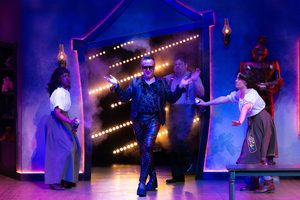
As the centerpiece, Adams does his best to nurture and stay anchored amid the story’s organized chaos as it unfolds under the direction of Darnell Pierre Benjamin and written by the award-winning Katori Hall. There are many layers to peel back, which can be overwhelming at times, but the story manages with grace and ease, punctuated by spurts of laughter and dancing (The Luther Vandross dance-off was a pleasant romp; who knew you could get down like that to ‘Never Too Much’?). The story unfolds like any family. Je’Shaun’s Isom character carries the zaniness and secret plot foil of the story alongside the complicated connection to barber Big Charles, played with conviction by Smith, who brings a balanced older wisdom to the dramedy. Cordell’s troubled soul and relationship with Dwayne may at times be overshadowed by the rest of the action, but they remain the foundation of The Hot Wing King.
In particular, the dynamics between E.J. and his ‘Uncles’ compared with his struggling father, T.J., form a layer that dominates the second half of the show, culminating in a heart-to-heart re-bonding that stands out. It shows promise for young Rogerick, who handled his life’s frustrations alongside the acting veteran Rico, and the subtleties between them feel like genuine parental relationships. While their dynamics are powerful, they are another layer of the core relationship between Cordell and Dwayne.
Furthermore, T. J.’s character could be portrayed as a less stereotypical street pharmaceutical representative. Any other ‘Macho’ parental type who disagrees with his brother-in-law’s lifestyle could have been substituted. There is also some discomfort with the blatant use of a derogatory word that ideally could be toned down and hopefully discontinued, though it is truly meant for the play’s core black, brown, and queer audience.
Design
Overall, I was, as always, impressed with the scenic designs engineered by the creative team of Tamara Honesty, the lighting by Mike Gaynor and Kelsey Gallagher, and the pristine sound by Derek Graham. The kitchen, living room, and upper bedroom looked like quite an adorable, functional abode, while the narrow outdoor area seemed a bit less efficient and could have used more space to function. Costumes are well done and supportive of each actor, by Daryl Harris. I especially appreciate the creative team’s sharing their exquisite blueprints with the audience.
Obviously timed with Pride and Black Music Month, The Hot Wing King is a safe space for queer Black and brown men. It’s also a place where Black love can foster and flourish amid evolving family dynamics. As Human Race offers a rich, diverse, equitable, and inclusive repertoire, the mismatched audience canon could be better marketed to move beyond traditional season-ticket holders and reach the target audiences.
Get Tickets to The Hot Wing King
Human Race Theatre’s The Hot Wing King runs through June 14 at Dayton’s Human Race Theatre Company space at the Loft. Get tickets HERE.

Christopher Joseph: My passion lies in writing. I embarked on a writing quest once a mysterious typewriter appeared on my family’s porch in Yellow Springs, Ohio. Constantly engulfed in art, drawing, music, and after years at many, many, odd jobs as fodder for many diverse stories to come; it was a natural progression. Visit my website: https://about.me/christopher.j88