By Liz Eichler
Everyone should see SUFFS, playing now through May 17, 2026 at the Aronoff Center. Not simply because it tells the history of women’s suffrage, but because it understands how exhausting, complicated, divisive, and necessary social progress can be.
Shaina Taub wrote the book, music and lyrics–and starred on Broadway. SUFFS won the 2024 Tony Awards for Best Book and Best Score after a development process through New York’s Public Theater and pandemic delays. What emerged is this sharply constructed musical about ambition, strategy, ego, sacrifice, and coalition building.

The Story and Characters
The musical centers on the ideological divide between longtime suffrage leader Carrie Chapman Catt (Marya Grandy) and the younger, more confrontational Alice Paul (Maya Keleher). Catt believes in patience, relationships, and political maneuvering. Paul wants immediate action, public protest, and disruption. Their conflict drives the show.
Catt has been fighting for over sixty years, politely asking “Let Mother Vote.” In 1913, Alice Paul wants to join the fight but she is rebuffed. So Paul forms her own group. They have no resources but “Find A Way,” leading a Women’s March on Pennsylvania Avenue (200,000 participants) and getting the attention of press and President Wilson.
Embracing their new status as the “Great American Bitch,” they accept Catt’s offer to join forces until personal friction breaks their alliance. Paul finds new resources, but loses one of her key members.
Act Two begins with “The Young are at the Gates,” a silent protest, which ends with Paul and her friends being arrested and jailed. They go on a hunger strike, however, to control the story, Wilson has them forcibly fed. This abuse is leaked to the press, leading to Wilson finally announcing support for the Amendment–sure congress would kill it. Down to one vote–a mother’s plea (Gretchen Shope) makes it happen.

Leadership
Director Leigh Silverman keeps the production moving with striking stage pictures, particularly during the protest and march sequences. Choreographer Mayte Natalio gives each demonstration its own physical identity, from carefully organized political spectacle to chaotic confrontation. The juxtaposition of the two movements in “Fire and Tea” is evident. One especially effective recurring visual uses silhouettes to remind the audience that the fight extends beyond any one woman or personality.
The touring production also sounds fantastic. Under Andrea Grody’s musical direction, with Conductor Dani Lee Hutch, the ensemble harmonies are rich, while Jason Crystal’s sound design generally balances orchestra and vocals well. The recurring anthem “Find A Way” lands repeatedly throughout the show without losing emotional force.
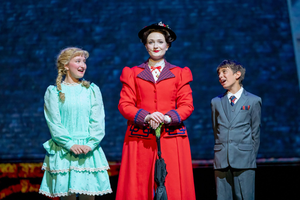
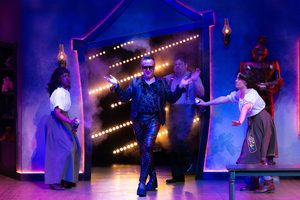
Tour scenic designer Christine Peters, adapting Riccardo Hernandez’s original Broadway design, uses wood-look sliding panels and iron gates to create fluid transitions between political offices, protests, prison cells, and convention halls. Lap Chi Chu’s lighting adds the hues of emotion without overwhelming the performances, particularly through sharp spotlight work and flashes that evoke early press photography. Costumes are beautifully designed by the inimitable Paul Tazewell, full of godets and pleats of the time, and a variety of hemlines.

of SUFFS. Photo by Joan Marcus, 2025.
Performances
Maya Keleher gives Alice Paul a relentless drive, with intense eldest daughter energy. She delivers her songs with passion and control. Her Alice is more than an inspirational hero, Keleher shows her humanity with flashes of stubbornness and tunnel vision alongside her charisma.
Marya Grandy is compelling as Carrie Chapman Catt. Rather than portraying her as merely conservative or resistant to change, Grandy emphasizes the exhaustion of someone who has spent decades fighting the same battle. “This Girl” is a warning from her own experience.
One of the musical’s smartest choices is its willingness to confront the racism within the suffrage movement itself. Danyel Fulton’s Ida B. Wells refuses to let the audience romanticize history, and “Wait My Turn” lands as one of the evening’s most powerful moments. The audience vocalises their disbelief when she is told to “wait your turn.” Fulton delivers the song with both fury and restraint–giving Paul the pushback to chart the course to victory.
The supporting cast is uniformly strong. Gwynne Wood brings an eager, slightly chaotic warmth that recalls the optimistic energy of a young political volunteer discovering her purpose for the first time. Joyce Meimei Zheng’s Ruza Wenclawska provides fire and comic timing, while Livvy Marcus gives Doris Stevens an appealing mix of wit and sincerity, particularly in “If We Were Married.” Monica Tulia Ramirez’s Inez Milholland possesses a striking vocal quality that cuts through beautifully during key moments.
Jenny Ashman’s Woodrow Wilson has the appropriate power and sleeze of an elected official. Brandi Porter’s Dudley Malone is quietly charming and brave. I wanted to hear more from Victoria Pekel’s intriguing Phyllis and Robin.


National Touring of SUFFS. Photo by Joan Marcus.
Conclusion – See SUFFS
What makes SUFFS resonate now is not simply that these events happened, but that the arguments feel painfully familiar. Who gets included in movements? How much compromise is acceptable? When does pragmatism become complacency? When does idealism become self-destruction? Hopefully the movement’s work was not in vain–as today factions are working to dismantle the 19th Amendment.
At intermission, the woman next to me turned to her daughter and said, “I didn’t know any of this. Why didn’t we learn this in school?” Her daughter answered immediately: “History is written by the people in power.”
That exchange may have summarized the show better than anything else.
SUFFS never argues that progress is clean or inevitable. It argues that it is messy, imperfect, exhausting work carried forward by flawed people who often disagree with one another. That honesty is what makes the musical feel alive rather than dutiful.
And yes — this is a show people should bring their spouses and teenagers to see. Sons and husbands included.
SUFFS continues through May 17, 2026, as part of the Broadway in Cincinnati series. Tickets are available HERE.