By Doug Iden
Juliet narrates her family’s survival in a brutal 1960’s Romanian Gulag in a regional premier running at the Falcon Theatre.
In an extraordinary one-woman performance, Samantha Joy Weil enacts the actual story of Juliet’s imprisonment along with her seven children, one of whom is the Playwright Andras Visky who was two years old when they were arrested.
Juliet’s Story
It’s told primarily in flashback but not narrated serially. Juliet’s husband Ferenc, is a Protestant paster who had escaped Romania early in World War II, met Juliet and later returned to, now, Communist Romania. Ferenc is accused of sedition by preaching religion in a country that denounces God and is sentenced to a 22-year imprisonment. Later, Juliet and her children are arrested and sent to a different Labor Camp. In a state of partial delirium, Juliet describes the arrest, the five-day trek to the Gulag and her first days in a “house” with no roof, dirt floor and one blanket for all of them.
Frightened but not cowered, Juliet learns survival techniques but she is Hungarian and does not speak Romanian. She eventually learns it with the help of her oldest child. With meager food, they learn to escape the camp at night and forage for food and anything else to help them endure.
Her Internment Continues
Throughout, Juliet worries about her husband–is he alive or not? She also questions his thirst for religion and God. She is unconvinced but her husband is steadfast. As their interment continues, she increasingly questions divine intervention and even transfixes on the notion of a love triangle between herself, her husband and, initially, the Maiden of Death and finally God. Is this reality or delusion or desperation? She befriends a feisty woman in the camp who, mildly, defies the authorities which helps give Juliet additional strength. In a critical dramatic scene, a government legal official, offers Juliet the opportunity to free herself and her children if she agrees to divorce her husband and, by inference, provide “favors” to the lawyer. Now, she knows her husband is alive but will she accept the offer?
Themes
The themes are many and multilayered. Overarching is imprisonment and how does that impact peope, both physically and spiritually? Survival is essential, sometimes through action and occasionally through near insanity. Famile love is central to retaining strength. Also, the role of religion. Religious beliefs caused their situation but is it worth anything and is it real? Communism and unfeeling dictatorship are excoriated.
Production Team
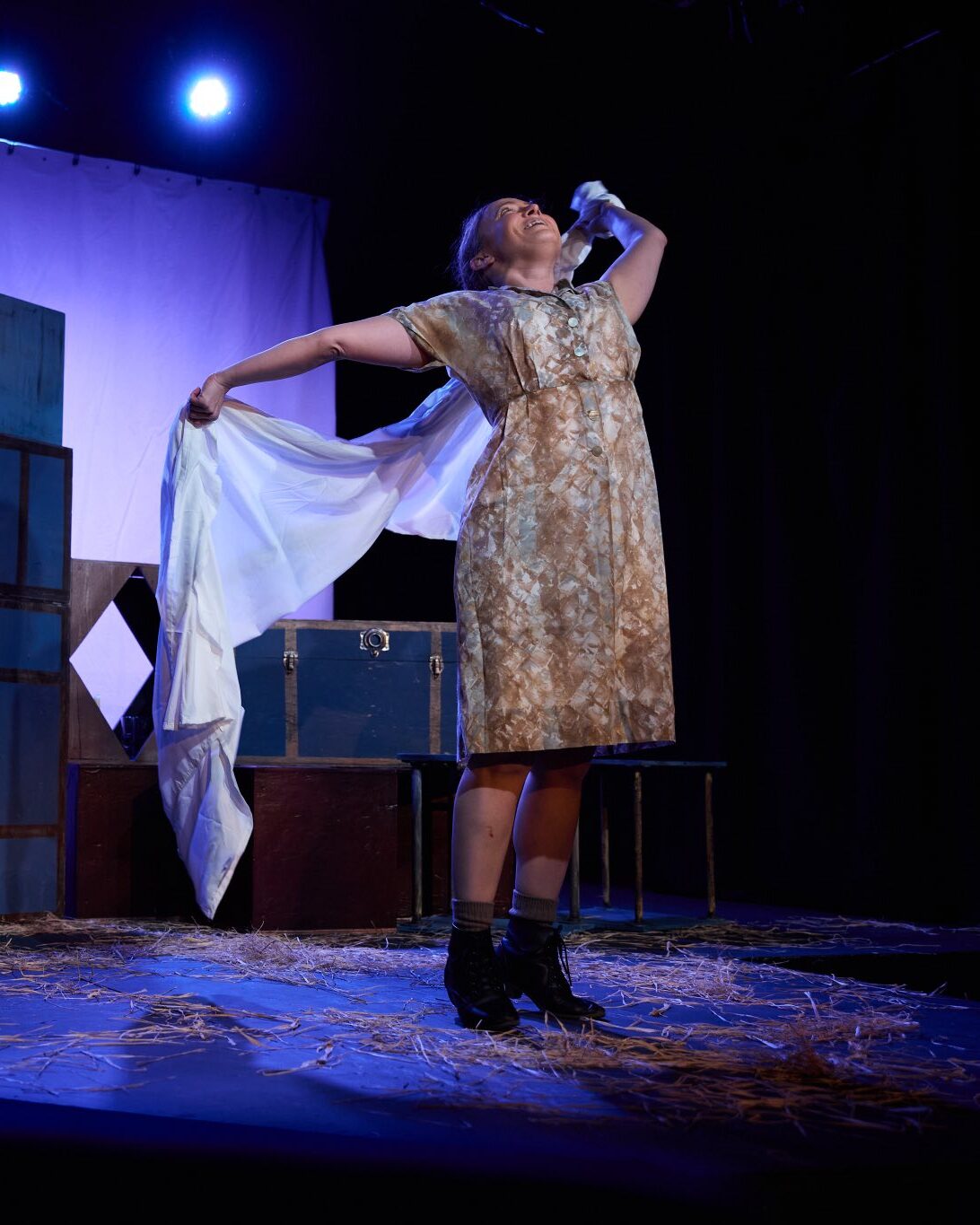
Weil’s performance is outstanding. She careens from hope to despair, from reality to delirium, from action to passivity, from religiosity to doubt. She also portrays multiple characters, through acting, not mimicry. She voices her husband, the Maiden of Death, her children, the feisty camp woman, and various dignitaries. Constantly in motion, she roams the mostly bare stage, climbs on several props, plays with the straw on the ground and often ventures into the crowd.
The staging and scenic design by Weil and Director Zoe Peterson is also fascinating with several symbolic props. The sole blanket which the family is given almost becomes a character. It subs as warmth and comfort, several different articles of clothing and a screen for shadow acting. Weil portrays the Maiden of Death, the camp lady, and some others from behind the screen which is backlit by Lighting Designer Ted Weil (who is also the Artistic Director and husband of Samantha). Juliet’s husband is represented by a shirt to which she speaks, hugs and, occasionally, disparages. Another interesting illusion is the use of simulated puppetry explaining her two rings (marriage to husband and God). Weil goes behind a diamond shaped prop, and uses her hands to recreate the characters in her “play.” Weil designed her costume with Rachel Scardina. It is a dress (not a prison uniform) with combat boots.
Overall
This is a powerful, intense play which applauds the human spirit but is tough to watch at times. The play is beautifully written and very poetic, enhanced by Weil’s characterization. You will think about this play long after you have left the theater.
Juliet is running at the Falcon Theatre through December 20. Get tickets HERE.