
By Ella Widau
There’s something deeply uncomfortable about watching polite society slowly unravel, and in the Gem City Groundlings’ production of God of Carnage, director Andrew Mitakides leans fully into that discomfort. What begins as a calm, civilized meeting between two sets of parents quickly slides into accusations, insults, and the surfacing of some very ugly truths. In this staging, the unease is apparent almost immediately—and it only builds from there.
Setting the Stage
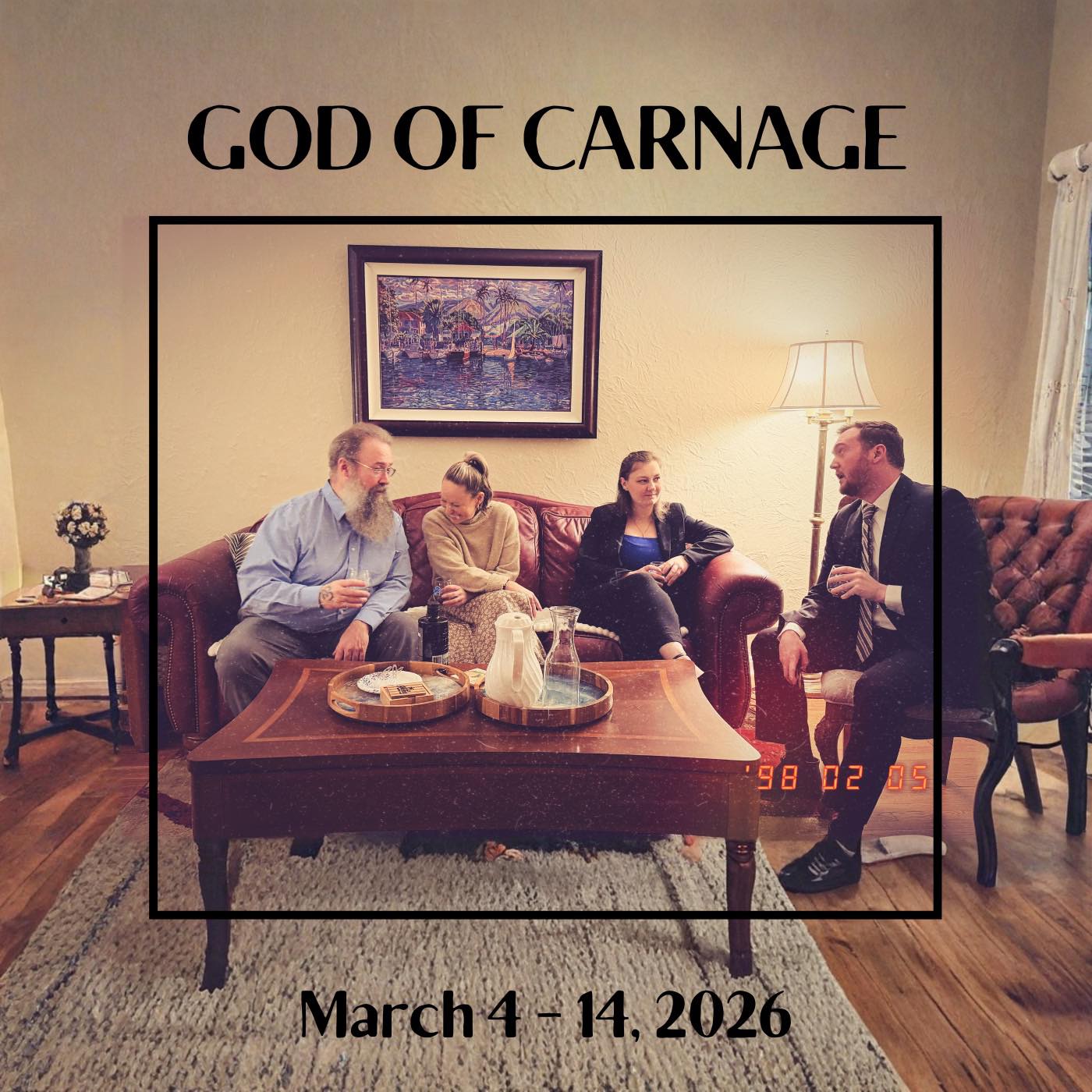
The set immediately draws attention from the moment you step into the room. It’s thoughtfully designed to pull the audience into the play’s world, making it feel as though we are almost part of the tense living room conversation. The layout invites a sense of intimacy that works perfectly for a show built entirely around four people trapped together in a room.
Even before the actors appear, the tone is set. The opening music hints that this “civilized” meeting isn’t likely to stay polite for long. Forsthoefel also handles the production’s sound and lighting design, which quietly support the shifting mood of the play without ever distracting from the action.
The production also makes excellent use of the space. Characters frequently move through the audience to reach ‘other rooms’ in the home, a simple yet effective staging choice that expands the play’s world while keeping the central conflict focused in the audience’s line of sight.
Performances and Character Dynamics
Each actor fills their role remarkably well. Corinne Zimmer and Don Smith play Veronica and Michael Novak. Racheal Tingley and Dylan Lee Jackson play Annette and Alan Raleigh.
At first, there’s a hint that the two mothers might find some common ground. Their early interactions suggest a polite solidarity, but it’s hard to tell whether that bond is genuine or simply social performance.
The small details add a lot of depth to these interactions. One especially telling moment occurs when Alan refuses to shake Veronica’s hand, not once, but twice. It’s a subtle gesture, but it speaks volumes about his character and the dynamics beginning to unfold in the room.
Jackson’s Alan, the lawyer, is particularly fascinating to watch, if only because he’s so infuriating. While the other characters show flashes of both kindness and cruelty, Alan seems almost completely detached from the social rules everyone else is trying to maintain, at least at the beginning of the conflict. When he casually answers phone calls in the middle of tense discussion, over and over again, the discomfort is felt by everyone in the room.
Escalating Conflict
As the conversation shifts from topic to topic, the alliances change constantly. Each new argument reshuffles the teams; the couples either battle each other directly or divide along gender lines, with the wives joining forces against the husbands and vice versa. The shifting dynamics keep the tension alive and unpredictable.
Meanwhile, the visiting couple, Alan and Annette, repeatedly attempt to leave the apartment. Again and again, they make their way toward the exit, only to return moments later after a new insult or accusation pulls them back into the fight. The cycle becomes both hilarious and excruciating, capturing the irresistible pull of unresolved conflict, and sense of self.
The actors are succeeding in exactly what the play demands: exposing the ugliness beneath carefully constructed civility.
Thoughtful Stagecraft
Another strength of the production is its purposeful use of props. Each object contributes to the escalating tension, reinforcing the sense that this carefully curated living room is also slowly falling apart.
Behind the scenes, assistant director and stage manager Greg Forsthoefel keeps the evening running smoothly, while executive producer Riki Mitakides supports the production’s overall presentation. The actors provide their own clothing, and Andrew Mitakides serves as scenic designer.
A Worthwhile Evening
Gem City Groundlings’ God of Carnage delivers biting humor, uncomfortable truths, and four people pushed to the brink of social collapse. With smart staging, strong casting, and performances that fully embrace the chaos, it’s a compelling reminder that beneath our polite conversations and civilized gestures, the “god of carnage” may not be very far away.
Gem City Groundlings’ God of Carnage runs March 12-14 and moves from the Lift to the Brick & Beam in Centerville, Ohio. Get tickets HERE.